
Cycles: 700, 45 & 10 Years
Patterns for the Prediction of Future Events
J. H. L. Lawler — August 1990
Three Interlocking Cycles
700-Year Cycle
Rise & fall of empires and civilizations
45-Year Cycle
Science vs. humanities innovation & wars
10-Year Cycle
U.S. economic rhythm — two centuries documented
History is not random. Beneath the apparent chaos of human events lie three distinct, interlocking cycles — each operating at a different timescale, each independently documented, and each capable of generating testable predictions about the future.
The first is the 700-year (or 1400-year) cycle of the rise and fall of empires and whole civilizations. The second is the 45-year cycle of innovation — alternating between science and the humanities — and of great and minor wars. The third is the 10-year cycle of the U.S. economy, documented for the last two centuries.
The main purpose of memory — and the extended memory we call recorded history — is to predict the future. History is the database from which our minds create patterns, and with these patterns we predict what will happen from any given set of circumstances. Those who refuse to learn from history are forever doomed to repeat it.
The 700-Year Cycle of Civilizations
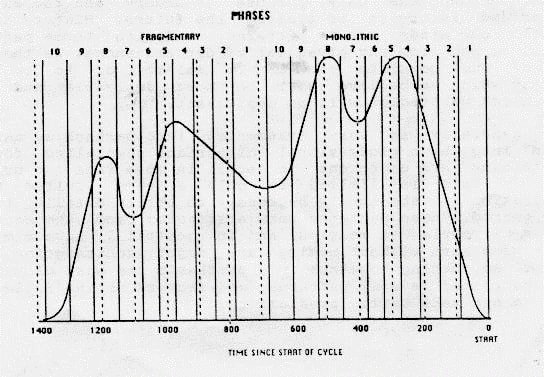
~700 YearsThere is a pattern of the rise and fall of empires — of whole civilizations — which repeats with approximately a 700-year cycle. The cycles alternate between monolithic empires and fragmentary empires. There is a complete collapse of civilization every 1400 years, so this could be called a 1400-year cycle. But all major empires rise and collapse every 700 years in synchronism, making the 700-year cycle the primary analytical unit.
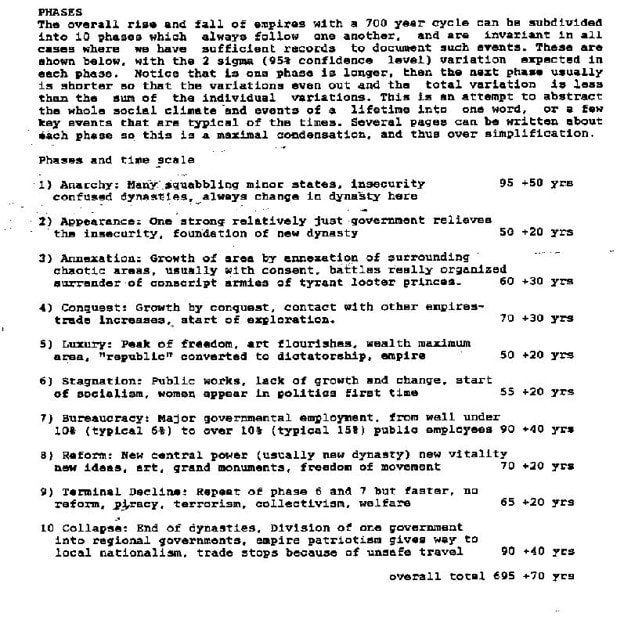
This has been documented for more than 150 major empires, and for many smaller cultures, with no major exceptions. The 700-year pattern can be subdivided into ten phases or smaller trends — a convenient subdivision that allows prediction of trends lasting most of one person's lifetime.
Monolithic Empires
Occur at ~1500 AD, ~100 AD, ~1400 BC, ~2700 BC, ~4200 BC, etc. Characterized by clearly established dynasties, well-defined governmental policies, expanding boundaries, and the accumulation of excess wealth — which funds major monuments: the Pyramids, Roman roads and amphitheaters, the Hanging Gardens of Babylon. When they collapse, the resulting anarchy is less severe because of accumulated reserves.
Fragmentary Empires
Occur at ~800 AD, ~500 BC, ~1900 BC, ~3300 BC, etc. They mimic the preceding monolithic empire but lack clear definition, suffer unstable governments, and lack social cohesion. The Byzantine and 'Holy Roman Empire' — neither holy, nor Roman, nor a true empire — are classic examples. They lack the excess wealth for major projects, and their collapse leads to total anarchy: the Dark Ages.
Current Cycle Warning
Present societies appear doomed to collapse because of seemingly attractive short-range decisions made years ago — the theft of capital for immediate consumption — now leading to lower production, shortages, and demands for yet more consumption of capital. The cycle can be broken, but only by understanding the consequences of choices and making decisions for long-range prosperity rather than short-range gain.
The Ten Phases
The 700-year cycle can be subdivided into ten phases which always follow one another, invariant in all cases where sufficient records exist to document them. Each phase has a characteristic duration with a 2-sigma (95% confidence) variation. Notice that if one phase is longer, the next is usually shorter — so the total variation is less than the sum of the individual variations.
The 45-Year Science / Humanities Cycle
~45 YearsIndependent of the 700-year cycle, there is a 45-year cycle of humanities and science that alternates like a pendulum. For approximately 20 years (half the cycle) there is much innovation in science while the humanities are conservative — virtually no experimentation in social relationships. The other half sees much innovation in the humanities while science is static and unchanging.
A major war is associated with each period of science innovation; a 'brush fire' or minor war is associated with each humanities period. Because wars are better recorded in history than innovations themselves, this pendulum-like alternation has been traced for 108 cycles back to approximately 3000 BC, with only one minor deviation.
This pattern, in association with the main 700-year pattern, allows reasonable prediction of overall events — including the timing of major wars, periods of scientific breakthrough, and periods of social upheaval.
Science Innovation Phase
Duration: ~20 years
Major scientific breakthroughs. Humanities conservative — little social experimentation. Associated with a major war. Dynasty changes frequent.
1989–2009, 2034–2054, 2079–2099
Humanities Innovation Phase
Duration: ~25 years
Social and cultural experimentation. Science static and unchanging. Associated with a minor 'brush fire' war.
2012–2032, 2057–2077, 2102–2122
Predictive Formulas
Major Wars
1999 + 45n ±10 years
e.g. ~2044, ~2089, ~2134…
Minor Wars
1977 + 45n ±10 years
e.g. ~2022, ~2067, ~2112…
The 10-Year Economic Cycle
~10 YearsA 10-year cycle of the U.S. economy has been documented for the last two centuries. This cycle must be added into the analysis of the 45-year and 700-year cycles. When all three cycles align — as in the 2019–2023 period — the result is a major depression of historic severity. The economic 10-year cycle also interacts with the science/humanities alternation of the 45-year cycle, modulating the intensity of both innovation periods and war events.
History as Predictive Database
History is generally fragmented into perhaps as many as a thousand 'periods' into which professional historians specialize. Few if any historians are competent in detail in more than two or three cultures, and usually only within a very limited time span. This specialization is absolutely necessary to obtain detailed information about any one period.
These patterns were abstracted from the works and analysis of too many people to mention. The contribution here is synthesis — putting together the work of many specialists to abstract the patterns and factors that allow better predictions. The goal is not to replace detailed historical scholarship but to identify the meta-patterns that cut across all civilizations.
There is hope that we can, perhaps someday in the far future, break out of the pattern — particularly the collapse part — by studying the factors that drive it and avoiding the choices that lead to unpleasant results. But this requires enough people to understand the consequences of their choices before those choices are made.
Those who refuse to learn from history are forever doomed to repeat history.
— J. H. L. Lawler