
Global Warming
Pacific Decadal Oscillations, El Niño & La Niña, Greenhouse Effect, and Rise in Ocean Levels
J. H. L. Lawler
Warming or Ice Age — Which Is It?
Both global warming and a return to an ice age have been proposed. Which is it to be? Are we getting hotter with global flooding? Are we going to get colder and have a return to an ice age with glaciation?
The answer — unfortunately — appears to be yes.
There is reason to think that we are headed into a major temperature spike with flooding which will be far worse than anything mankind has inflicted upon itself to date. Worse, this spike is a trigger event that causes major climatic shifts that in turn cause an over-reaction, bringing on major, very rapid glaciation.
The Flooding
The warming alone will upset ecosystems — a disaster. But that is mild compared to the devastation caused by flooding. Almost all coastal cities will be flooded out, taking more than half the industrial base with them, and more than half the best farmland.
The Americas
Amazonia becomes a shallow inland sea, with the island of Venezuela cut off from the Andes.
Europe
Paris becomes a port city. Holland, Belgium, and Ireland are lost. All that remains of Russia is the Ural Archipelago.
Asia — Worst Hit
China loses most of its heartland. India loses the Indus and Ganges river valleys. More than a billion people have no place left to live, work, or grow crops, and are forced to move.
The Double Whammy — Rapid Glaciation
Bad enough? Not quite — for the flooding is just the first of a double whammy. The next stage is a major shift in ocean currents, as the new Arctic circum-polar current triggers a southward shift in the Gulf Stream.
That shifts the major rain from Europe to Africa, returning the Sahara to its former verdant state — at least one good thing. But it leaves the shallow sea where Russia used to be under a massive cold zone, which causes a freeze-over.
White snow covers the ice and reflects heat from the sun, allowing summer to be colder — much colder. The loss of heat is so rapid and so great that after a few years (under ten) there is a 'Fimbul Winter' of Nordic legend, where the snow never completely melts and starts a rapid accumulation. 'The year there was no summer.'
The Scale of Natural Forces
This is not man-caused. Our activities have not helped the situation and have speeded it up — but the forces here are far beyond anything we ourselves have been able to create.
One Summer Lightning Storm
≈ Total U.S. annual electrical generation
A single evening storm in the Grand Teton Mountains — and lightning is only a by-product, almost ignorable compared to the energy of the storm itself.
One Hurricane — One Hour
> All energy ever used by mankind
More energy in one hour than all fires, oil, coal, and nuclear bombs combined — from the first cave fires to the present.
What We Have Actually Done
Over time we have had an effect — rarely if ever a good one. We have stripped vegetation from hills and turned cities in the Middle East, founded upon the resources of trees and farmland, into abandoned rocky hillsides. The former harbor is a silted-up marsh filled with the topsoil that had made the site so desirable millennia ago.
We have accelerated the desertification of the Sahara and other dry grasslands, and accelerated the drying up of former Lake Niger and the Aral Sea. Overgrazing accelerated a process of desertification already underway. The largest recent criminal mismanagement is the destruction of the rain forests in Brazil.
Not to worry, however — as nature is about to apply her own form of justice. Those who cut the forest in Brazil are about to be evicted as the Amazon basin becomes once more the Amazon Sea. It was a sea before, and it is about to become so once more.
Cause and Effect — Reversed
52×
Water vapor's greenhouse effect vs. CO₂
CO₂ accounts for less than 2% of the total greenhouse effect. Clouds are stronger still.
Global warming is real. The UN-sponsored Intergovernmental Panel on Climate Change, meeting in October 2000, doubled its predicted warming from 1.5–3.5°C (1995 estimate) to 3–6°C. All factors in the 2000 estimate tended to increase from original estimates.
But this panel was also partially politically motivated, missing major factors that are politically incorrect and fixing attention on CO₂-based greenhouse effect — which is now known to be trivial. They also totally failed to present the probable results of this warming and its secondary effects, which will be catastrophic.
Close examination of temperature and CO₂ levels shows that these two are co-functional: when ocean and global temperatures rise, CO₂ concentrations in the atmosphere also rise. This was erroneously taken to mean that CO₂ via greenhouse effect caused a rise in temperature. But closer examination shows that first the temperature rises and then later the CO₂ rises — meaning that temperature causes CO₂ rise, not the other way around.
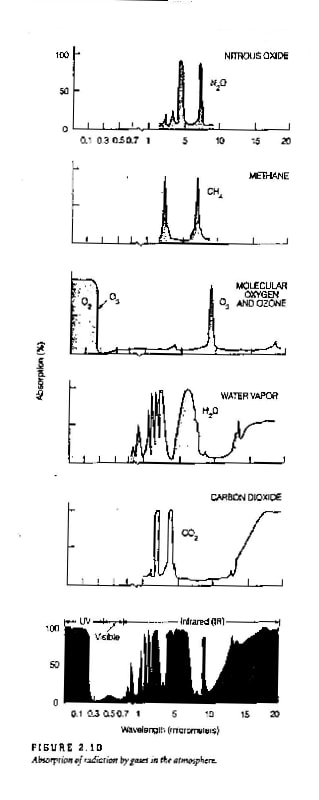
Water vapor alone — ignoring clouds — has 52 times the greenhouse effect of CO₂. CO₂ is only somewhat less than 2% of that effect. Clouds have an even stronger effect than water vapor, as they are white and reflect sunlight. The cutting of rainforests has reduced water transpiration to the atmosphere, which has cut the daily deluge in rainfall from transpiration-fed clouds — and that has had a measurable effect.
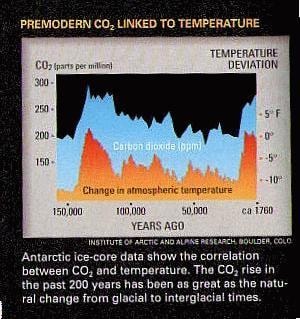
Institute of Arctic and Alpine Research, Boulder, Colorado
Redirecting Our Efforts
First we must recognize what we can control and what is beyond our control — and prepare for that which we cannot control.
Reforestation
The loss of rainforest can be reversed by reforestation — not necessarily with the same plants, but with high-transpiration species, not grass or low-transpiration ground cover. That will pump more water into the air, making more clouds which reflect incoming heat.
Halt Saharan Desertification
Overgrazing in the Sahara can be halted and new irrigated green plants introduced — heat-rejecting ground cover, not fodder grasses. With extremely careful control we can possibly reverse that desertification.
Genetically Modified Barley on Brackish Water
Genetically modified barley crops irrigated with brackish water (almost sea water) can place millions of hectares into cultivation — feeding a hungry world, converting energy into chemical rather than heat form, and introducing water vapor back into the air to help with cloud cover creation.
Space-Based Solar Management
A simple set of rings about the equator, or in trans-polar position, can reflect light away from the equator to cool it and reflect light to the northern tundra to warm that area. It is not possible to generate or cool energy on the scale of solar insolation — but it IS possible to control and direct the incoming solar energy. This requires a viable space launch system and immediate redirection of major resources into space programs.
Invest in Space
Invest at least as much into space programs — which are vital for racial survival — as is now placed into entertainment. High-tech programs pay for themselves many times over. They supply jobs in a cascade down and create whole new industries which cannot even be imagined at the start of the process. The entire microchip–computer–semiconductor industry came out of the Apollo program.
It is not possible for us to produce cooling or heating on the scale of solar insolation by many orders of magnitude. However, it IS possible to control and direct the incoming solar energy.
— J. H. L. Lawler — Lima, Peru, 2000